Home Page

Recall Reality: The Hidden Gamble in Your Vitamin Cabinet

Dietary supplements are widely used by breastfeeding women, yet many lack proven safety, efficacy, and consistent quality due to limited regulatory oversight. Variability in product content, misleading labeling, and reactive (rather than proactive) FDA oversight mean that consumers may unknowingly be exposed to ineffective or even harmful products. While third-party certification can help mitigate some risk, supplement use in lactation should be approached with caution, as product safety cannot be assumed based on labeling or “natural” claims alone.
What Breastfeeding Moms Need to Know About Tirzepatide
Current evidence suggests that tirzepatide does not meaningfully transfer into breast milk. The larger concern during breastfeeding is not drug exposure, but reduced calorie and nutrient intake due to...
Platelet-Rich Plasma (PRP) Treatments and Breastfeeding
PRP is a minimally invasive treatment that harnesses your body’s own healing mechanisms to rejuvenate skin and stimulate hair growth. For breastfeeding mothers, current evidence is highly reassuring: ...
How to Report Infant Medication Side Effects from Breastfeeding
If you notice changes in your baby while breastfeeding on medication—even something as small as fussiness or diarrhea—it may be worth reporting. Many parents don’t realize that these experiences can b...

Research


Every year, the InfantRisk Center publishes studies on the transfer of various drugs into breast milk. We invite you to review these studies and consider participating in one of them. Participation is simple: you will need to collect samples of your breast milk at regular intervals, freeze them, and send them to our laboratories using prepaid overnight mailing. Your involvement will greatly contribute to our research and help ensure the safety of medications for breastfeeding mothers.


 

Participate in Research

Postnatal Vitamins While Breastfeeding

For decades, prenatal vitamins have been available and recommended by providers. Pregnancy is a time of intense physiological change both for mother and baby, and appropriate supplementation of variou...

Esketamine and Breastfeeding

Esketamine can be part of the psychiatric management of treatment-resistant depression and its compatibility with breastfeeding is currently unknown. Esketamine likely penetrates breastmilk to a low d...

Antibodies, the Immune System, & Breastfeeding: The Basics

Antibodies are a known benefit of breastfeeding. A specific type of antibody found in breastmilk, IgA, protects infants from infections.

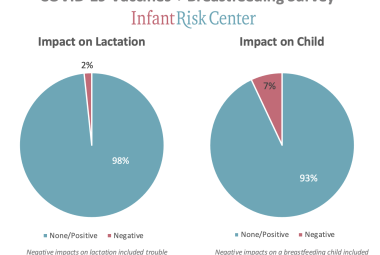
Results from Breastfeeding and COVID-19 Vaccine Survey

Results are in!!! What did we find out from 4,455 moms who chose to vaccinate while breastfeeding?

Cariprazine Induced Adverse Effects in Breastfed Infants?

The InfantRisk Center recommends cariprazine be avoided in breastfeeding women if possible. Possible adverse effects in the infants could include extrapyramidal and/or withdrawal symptoms, including a...

COVID-19 Vaccines, Mechanisms, and Breast Milk Antibodies

Infants’ immune systems are immature, so they rely on maternal antibodies given through breast milk. Maternal vaccination and subsequent breastfeeding can provide the benefits of vaccination to infant...

Fad Diets During Pregnancy

It seems there is always a new diet that becomes “trendy” or popular in the media, many of which tout “healthier” or “clean” eating. It is important to consider that such diets may have negative effec...

Breastfeeding, Caffeine, and Energy Drinks

Caffeine is the most widely consumed stimulant in the world. As such, the safety of caffeine-containing drinks during lactation can raise a lot of questions for new mothers. Post-partum fatigue and fr...

ADHD Medications and Breastfeeding

For most lactating mothers with ADHD, the benefits of breastfeeding outweigh the risks of concurrent treatment with stimulants, the most commonly prescribed medications. Few patients with ADHD require...